
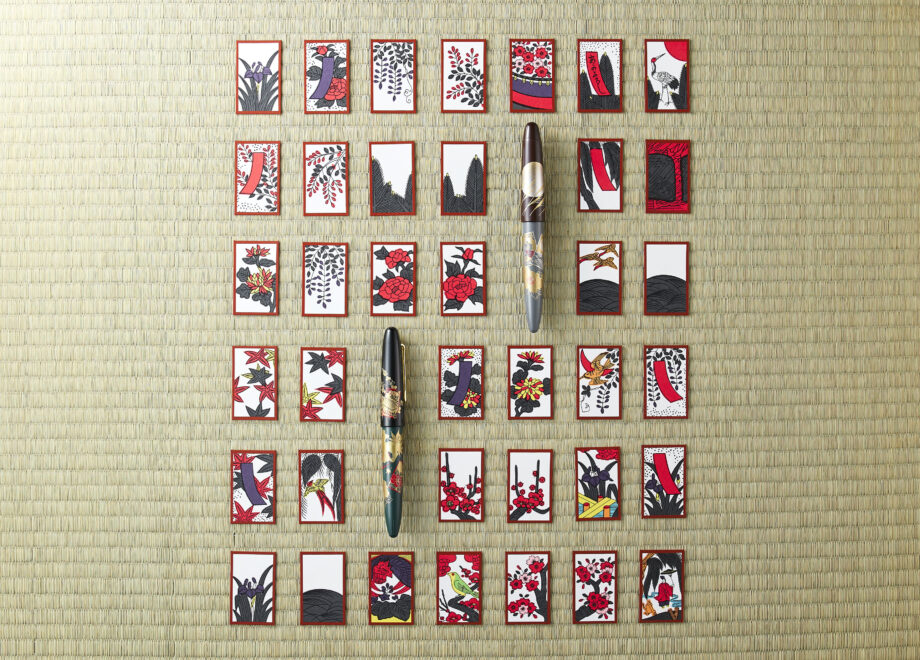
The Hanafuda pair among the playing cards that inspired it. Photograph: Sailor.
The collection began with my own acquisitions and has been built over many years, with much of its growth taking place in the last few. Small editions have become a particular interest: pens made in runs of a hundred pieces or fewer, sometimes considerably fewer.
The number matters to me. It is part of the appeal of owning one of a small edition, and I would be avoiding an aspect of my own collecting if I left it out. But a number is only one part of the decision. I also want to know what has been made, who made it, and why that particular pen appeals to me.
Design, colour and craftsmanship all enter into that choice. So does the story behind the work. A pen can bring these together in a way that makes me want to spend more time with it. The Sailor King of Pen Hanafuda pair does that especially well.
What drew me to the pair
I find these pens a beautiful interpretation of Hanafuda, the Japanese card game. The concept interests me because it gives the paintings a subject and a relationship to each other. I see a pair conceived around an idea, with the colour choices and painted detail contributing to its expression.
The contrast between the body and cap palettes is particularly compelling. It is a strong choice, and one of the things I admire most about them. The colours give the pair an immediate presence; the intricate paintings then invite a closer look.


The artist’s story was another reason for my interest. Sailor identifies him as Isana Kobayashi and describes a process combining Yubi maki-e underdrawings with maki-e applied individually by hand. Each barrel carries his hand-painted signature and serial number.[1] Knowing whose work I am looking at matters to me, particularly when so much of the attraction lies in the painting itself.
There are only 58 pieces of each design. The edition number is painted onto each barrel and appears on its accompanying certificate.[2] That is an unusually small edition, and it contributed to my interest in acquiring the pair. Alongside the interpretation of the game, the contrasting palettes and the artist’s work, it was another reason these pens stood out to me.
What ownership has added
My opinion has not changed since acquiring them. I still find them beautiful, and the choices that first appealed to me continue to do so. What has developed is my appreciation of the mastery involved in these intricate paintings, and of how much they can tell on such a small canvas.
I keep discovering little details when I look at them. That has become a particular pleasure of owning this set. I can return to something I already know and still find that I have more to see.
This is something I want to explore in writing about the collection. The decision to acquire a pen is one part of its story. Having it over time gives me an opportunity to consider that decision again. Does it still hold my interest? Do I appreciate something I initially overlooked? Has my judgment changed?
With the Hanafuda pair, the answer is that my initial response has held, while my appreciation of the work has grown. I don’t need to invent a change of opinion to explain why I keep returning to them.
Opening the collection
Many of the pens that will appear on Atelier Stilografico were acquired before I began this publication. Writing about them now gives me a chance to look back at those choices and explain them with the benefit of having lived with the objects.
I want to give each pen enough space to discuss what drew me to it and what I think of it now. Rarity will be part of some accounts. In others, the interest may lie more in a design, a material, an artist or a maker’s history. Those differences are part of what I want to examine as I work through the collection.
The Hanafuda pair is a good place to begin because it brings several of my interests together. I acquired it for reasons I can still recognise. I keep looking because the paintings continue to reward that interest.
Sources
[1] Sailor: Hanafuda, Japanese Playing Cards, KOP Fountain Pen.
[2] Edition numbering on the pens and their accompanying certificates, from the author’s collection.